

Representable Contract State
an XML-based canonical view of EVM contract state
Concept
Abstract
This ERC introduces IXMLRepresentableState, a standard interface and XML binding schema that allow an EVM smart contract to define a static XML template with machine-readable bindings to its state and view functions. Off-chain renderers use this template to build a canonical XML document representing the contract's state at a specific block, without incurring any on-chain gas cost.
A contract that claims to implement IXMLRepresentableState MUST be XML-complete: every piece of mutable state that the author considers semantically relevant MUST be represented in the XML via bindings, so that the rendered XML is a complete representation of the contract at a given (chain-id, address, block-number).
Additionally, this ERC defines an optional interface IXMLRepresentableStatePart for contracts that expose one or more partial XML templates representing selected views of their state (for example, a settlement context), without changing the semantics of the canonical full representation.
An optional external template include profile allows templates to be composed from integrity-protected XML fragments fetched through URI schemes such as https://, ipfs://, or ERC-4804/ERC-6860 web3:// / w3:// contract calls. This allows large document-style templates to be factored into reusable fragments while preserving deterministic, block-specific rendering semantics.
Motivation
Smart contracts can efficiently orchestrate and process the life cycle of a financial (derivative) product to the extent that they effectively represent the financial product itself.
At the same time, many applications require a human-readable, machine-parseable representation of that product and its state: valuation oracles need inputs for settlements; smart bonds and other tokenized instruments need legal terms, term sheets, or regulatory reports; and on-chain registries, governance modules, or vaults benefit from a stable “document view” of their state.
In the traditional off-chain world, such needs are addressed by standards like FpML, the ISDA Common Domain Model, or the ICMA Bond Data Taxonomy. A common pattern is to treat an XML (or similar) document as the definitive source defining the financial product and then generate code to interact with the corresponding data. When a process modifies or updates properties of the product, developers must synchronize the smart contract's internal state with the off-chain XML representation. Today, each project typically invents its own set of view functions and off-chain conventions, so clients need bespoke code to map contract state into XML, JSON, or PDF. This makes interoperability, independent auditing, and reuse of tooling harder.
This ERC inverts that pattern by putting the smart contract at the centre. A contract declares that it implements IXMLRepresentableState and defines an interface of representable state. Off-chain renderers can then derive a canonical XML representation that reflects the semantically relevant state of the contract at a given (chain-id, address, block-number), using only eth_call and a standardized XML binding schema. Rendering happens entirely off-chain and does not change state, so there is no gas cost, yet the resulting XML remains cryptographically anchored to the chain.
Typical use cases include:
- Smart derivative contracts that must present their current state to a valuation oracle or settlement engine.
- Smart bonds and other tokenized financial instruments that must generate legal terms, term sheets, or regulatory and supervisory reports.
- On-chain registries, governance modules, and vaults that want a reproducible, auditable document-style snapshot of their state.
By standardizing the Solidity interface and the XML attribute schema, this ERC allows generic tools to consume any compliant contract without project-specific adapters and to plug directly into existing XML-based workflows in finance and beyond.
Specification
The keywords “MUST”, “MUST NOT”, “REQUIRED”, “SHALL”, “SHALL NOT”, “SHOULD”, “SHOULD NOT”, “RECOMMENDED”, “MAY”, and “OPTIONAL” in this document are to be interpreted as described in RFC 2119 and RFC 8174.
Terminology
- XML template: A well-formed XML document, returned as a UTF-8 string by the contract, that contains placeholder bindings in the
evmstatenamespace. - Binding: An
evmstate:*attribute from the binding attribute set defined in this specification (e.g.,evmstate:call,evmstate:selector,evmstate:returns, …) that instructs a renderer to fetch a value from the contract (or from chain context) and insert it into the document. Optional profiles may define additionalevmstate:*attributes that are not bindings (e.g.,evmstate:integrityfor external template includes). - XML representation: The final XML document obtained by evaluating all bindings of the XML template against the contract at a specific (chain-id, address, block-number). Renderers MAY remove all
evmstate:*attributes from the output after evaluation. - Canonical XML representation: The semantic content of an XML representation at a given (chain-id, address, block-number), as defined by this ERC. This ERC does not require byte-for-byte identical XML serialization across renderers; for example, renderers may differ in optional removal of
evmstate:*attributes or in insignificant trailing zeros when renderingdecimalnumbers. - XML-complete contract: A contract that implements
IXMLRepresentableStateand whose XML representation encodes all semantically relevant mutable state. Informally, if two contracts are bytecode-identical and their canonical XML representations (as defined above) are equal at some block, their externally observable behaviour MUST be the same from that block onward. - Partial XML template: A well-formed XML document returned by
statePartXmlTemplate(partId)on a contract implementingIXMLRepresentableStatePart. It uses the sameevmstatebindings as the full template but is intended to represent only a selected view or projection of the contract state. - Partial XML view: The XML document obtained by rendering a partial XML template against a contract at a specific (chain-id, address, block-number). Partial XML views are not required to be XML-complete and MAY omit state that is present in the full XML representation.
- Template include: A
xi:includeelement (in the XInclude1 namespace) appearing in an XML template that instructs a renderer to fetch and merge an external or contract-served XML document into the template prior to evaluatingevmstatebindings. - Expanded XML template: The XML template obtained after all template includes (if any) have been resolved and merged.
Interface
The base interface is:
// SPDX-License-Identifier: CC0-1.0
pragma solidity ^0.8.19;

/**
 * @title XML Representable State interface
 * @notice Contracts implementing this interface expose an XML template that can be rendered
 *         into a canonical XML representation of the contract state at a given block.
 * @dev The XML binding schema and version are defined inside the XML itself (e.g., via
 *      namespaces or attributes). Snapshot consistency is achieved off-chain by evaluating
 *      all view calls against a single fixed block.
 */
interface IXMLRepresentableState {
    /**
     * @notice Returns the XML template string, using a dedicated namespace for bindings.
     * @dev Must return a well-formed XML 1.0 (or 1.1) document in UTF-8 encoding.
     *      Implementations SHOULD make this string independent of mutable contract state
     *      and environment variables, i.e., effectively constant.
     */
    function stateXmlTemplate() external view returns (string memory);
}
For contracts that want stronger off-chain tooling support (caching and integrity checks), optional extended interfaces are defined.
Versioned Extension
/**
 * @title Representable State (versioned) interface
 * @notice Adds a monotonically increasing version of the representable state. This optional
 *         extension allows off-chain tools to cheaply detect whether the representation-relevant
 *         state has changed.
 */
interface IRepresentableStateVersioned {
    /**
     * @notice Monotonically increasing version of the representable state.
     * @dev Implementations SHOULD increment this whenever any mutable state that participates
     *      in the representation changes. It MAY start at 0.
     *
     *      Off-chain tools MAY use this to:
     *        - cache rendered XML and skip recomputation if the version is unchanged;
     *        - provide a simple ordering of state changes.
     */
    function stateVersion() external view returns (uint256);
}
Hashed Extension
/**
 * @title Representable State (hashed) interface
 * @notice Exposes a hash of a canonical state tuple used for the representation.
 *         This optional extension allows off-chain tools to verify integrity of an
 *         externally provided representation against on-chain state.
 */
interface IRepresentableStateHashed {
    /**
     * @notice Hash of the canonical state tuple used for the representation.
     * @dev Implementations MAY choose their own canonical encoding of state (e.g.,
     *      abi.encode of a tuple of all fields that are represented).
     *
     *      This function is intended for off-chain integrity checks, for example:
     *        - parties can sign (chainId, contract, blockNumber, stateHash);
     *        - renderers can recompute the same hash from the values they used.
     *
     *      It is RECOMMENDED that stateHash() be implemented as a pure/view
     *      function that computes the hash on the fly, instead of storing it in
     *      contract storage and updating it on every change.
     */
    function stateHash() external view returns (bytes32);
}
Combined Convenience Extension
/**
 * @title XML Representable State (versioned) interface
 * @notice Convenience interface combining XML template and versioned state.
 */
interface IXMLRepresentableStateVersioned is IXMLRepresentableState, IRepresentableStateVersioned {}

/**
 * @title XML Representable State (hashed) interface
 * @notice Convenience interface combining XML template and hashed state.
 */
interface IXMLRepresentableStateHashed is IXMLRepresentableState, IRepresentableStateHashed {}

/**
 * @title XML Representable State (versioned + hashed) convenience interface
 * @notice Convenience interface combining XML template and versioned/hashed state.
 */
interface IXMLRepresentableStateVersionedHashed is IXMLRepresentableState, IRepresentableStateVersioned, IRepresentableStateHashed {}
A contract that implements any of these extended interfaces is also considered an implementation of IXMLRepresentableState.
Partial XML State Views (optional)
Some applications benefit from specialised views of the contract state (for example, a settlement context for a smart derivative contract) without needing to process the full XML representation.
To support such use cases, this ERC defines an optional interface that allows contracts to expose one or more partial XML templates keyed by an application-defined identifier:
/**
 * @title XML Representable State (partial) interface
 * @notice Optional extension exposing partial XML templates for selected views of the state.
 * @dev The meaning of partId is contract-specific or defined by higher-level standards.
 *
 *      Implementations of this interface alone are NOT required to be XML-complete:
 *      a contract may expose only partial views of its state without providing a
 *      canonical full XML representation via IXMLRepresentableState.
 */
interface IXMLRepresentableStatePart {
    /**
     * @notice Returns the XML template string for a particular partial state view.
     * @dev Must return a well-formed XML 1.0 (or 1.1) document in UTF-8 encoding.
     *      Implementations should make this string independent of mutable contract state
     *      and environment variables, i.e., effectively constant.
     *
     * @param partId Contract-specific identifier of the partial view.
     */
    function statePartXmlTemplate(uint256 partId) external view returns (string memory);
}
Contracts that implement both IXMLRepresentableState and IXMLRepresentableStatePart may optionally
declare a convenience interface:
/**
 * @title XML Representable State (full + parts) interface
 * @notice Convenience interface for contracts that provide a canonical full representation
 *         and one or more partial views.
 */
interface IXMLRepresentableStateWithParts is IXMLRepresentableState, IXMLRepresentableStatePart {}
Higher-level standards MAY reserve specific partId values for well-known views. Implementations
that define their own partId mapping SHOULD document it in their contract documentation or
off-chain specification.
Representable Contract State Referenced in Events
Events MAY carry compact references into a contract’s representable state. When they do, references SHOULD be expressed in a machine-readable URI format (see “Reference URI Scheme” below).
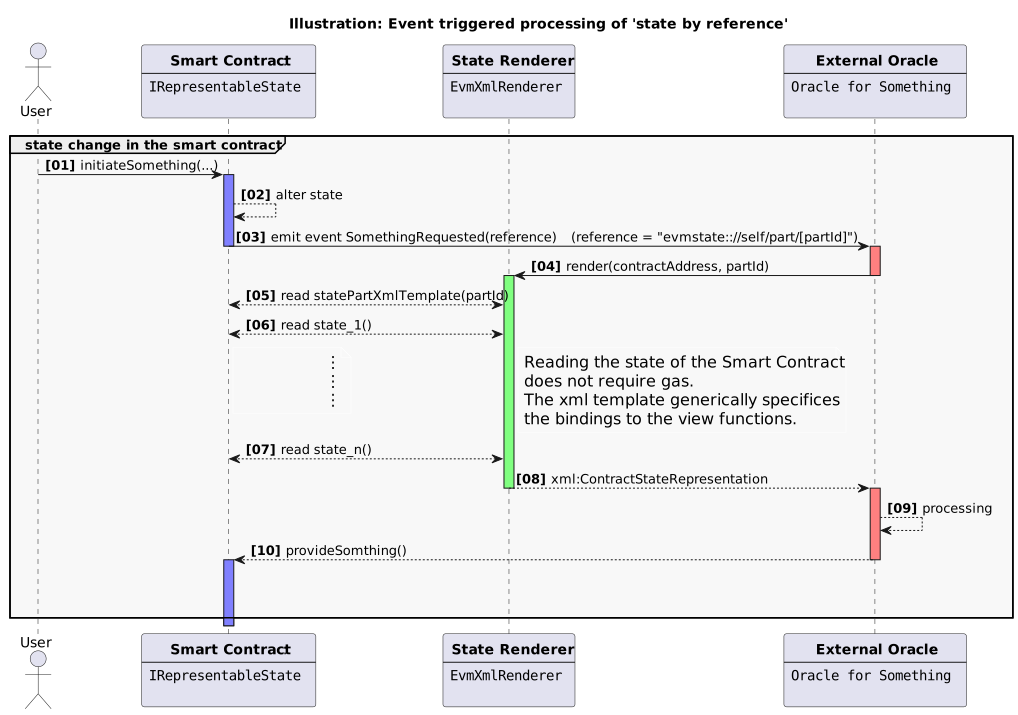
Example: Settlement Data by Reference
Consider an external settlement process triggered by the SettlementRequested event:
event SettlementRequested(address initiator, string tradeData, string lastSettlementData);
A straightforward interpretation of this event signature is that the full set of data required to perform a settlement is passed as part of the event parameters:
tradeDataencodes the information required to value the underlying trade.lastSettlementDataencodes the information required to compute the valuation margin using the previous settlement as an alignment point.
In many realistic deployments, large parts of tradeData and lastSettlementData are static or
slowly changing. Logging such data in every settlement request can therefore lead to unnecessary
gas consumption.
Contracts that implement both the above event and a representable contract state interface (for example, an XML-based representation exposed via read-only functions) should treat settlement events as compact references to the on-chain state rather than as self-contained data blobs.
Reference URI Scheme
When events carry references into a representable contract state, those references SHOULD be expressed in a machine-readable URI format. This ERC does not mandate a single URI scheme, but defines a simple RECOMMENDED pattern that is sufficient for most use cases.
For events that refer to the same contract that emitted the event (the most common case), the chain, contract address, and block number are already known from the log context. A reference into the representable state only needs to identify:
- which view is requested (for example, a particular
partIdforstatePartXmlTemplate), and - optionally, which version or instance of that view (for example, an index into a list of settlements).
This ERC RECOMMENDS the following minimal scheme for references to partial XML views:
evmstate://self/part/{partId}[?key={application-specific-key}]
where
selfindicates that the reference points to the contract that emitted the event;{partId}is the decimal or hexadecimal string representation of theuint256 partIdargument that would be passed tostatePartXmlTemplate(partId); and{application-specific-key}is an optional application-specific discriminator (e.g., a settlement index or timestamp).
Higher-level standards MAY define additional URI forms if they need to reference views on
different contracts or chains (for example,
evmstate://{chain-id}/{contract-address}/part/{partId}), but cross-contract references are
intentionally out of scope for this ERC.
The partId used in the URI is always a uint256 and corresponds directly to the partId
parameter of statePartXmlTemplate(uint256 partId). Standards that wish to define globally
unique part identifiers MAY define their partId constants as uint256 values derived from
a namespaced string, for example:
uint256 constant XML_PART_SETTLEMENT_CTX =
    uint256(keccak256("XML:SETTLEMENT-CONTEXT:v1"));
In that case, the URI would still carry the numeric identifier, for example:
evmstate://self/part/281092189917326349...
Informative Sequence Diagram
The following figure illustrates a typical event-triggered rendering flow. This figure is informative and does not introduce additional requirements beyond this specification.
XML Namespace
This ERC defines the XML namespace URI:
- Namespace URI:
urn:evm:state:1.0 - Recommended prefix:
evmstate
The XML template MUST declare this namespace, for example:
<Contract xmlns="urn:example:instrument"
          xmlns:evmstate="urn:evm:state:1.0">
    ...
</Contract>
This ERC additionally reuses the W3C XInclude1 namespace for optional external template composition (see “External template includes” below):
- XInclude namespace URI:
http://www.w3.org/2001/XInclude - Recommended prefix:
xi
External template includes
Smart contract bytecode size limits and compiler limits on string literal size may make it impractical to embed large XML templates fully on-chain. This section defines an OPTIONAL profile that allows an XML template returned by stateXmlTemplate() and/or statePartXmlTemplate(partId) to be composed from one or more externally hosted or contract-served XML documents using XInclude, while remaining integrity-protected by an on-chain hash.
An implementation (renderer) that supports this profile MUST implement the rules in this section.
An implementation (renderer) that does not support this profile MUST treat any occurrence of xi:include in a template as an error.
XInclude namespace
Templates that use this profile MUST declare the XInclude namespace:
- Namespace URI:
http://www.w3.org/2001/XInclude - Recommended prefix:
xi
Example:
<Contract xmlns="urn:example:instrument"
          xmlns:evmstate="urn:evm:state:1.0"
          xmlns:xi="http://www.w3.org/2001/XInclude">
  ...
</Contract>
Include element and required attributes
A template MAY contain one or more xi:include elements.
For this profile, each xi:include element MUST satisfy all of the following:
- It MUST have an
hrefattribute whose value is an absolute URI. - It MUST have an
evmstate:integrityattribute. - It MUST NOT have an
xpointerattribute (fragment selection is out of scope for this profile). - If a
parseattribute is present, its value MUST bexmlorapplication/xml. Text inclusion is out of scope.
The evmstate:integrity attribute is reserved by this ERC for use on xi:include elements only, and MUST NOT be interpreted as an evmstate binding.
Integrity format
For this profile, renderers MUST support integrity values of the form:
keccak256-0x{64hex}
where {64hex} is exactly 64 hexadecimal digits (case-insensitive), representing a 32-byte digest.
The digest is the EVM/Solidity keccak256 of the fetched resource content bytes (the octet sequence obtained from dereferencing href).
Renderers MAY support additional algorithms in the future, but MUST treat unknown algorithms as an error.
Supported URI schemes
This ERC does not require every renderer to support every absolute URI scheme. A renderer that supports the external template include profile MUST document the URI schemes it accepts and MUST reject unsupported schemes rather than silently falling back to a different transport.
Commonly useful schemes are:
http://andhttps://for ordinary web resources;ipfs://for content-addressed resources, typically resolved through a configured IPFS gateway or native IPFS client; andweb3://andw3://for contract-served fragments resolved through ERC-4804/ERC-6860 read-only EVM calls.23
A renderer MAY restrict the supported scheme set by configuration, for example to avoid network access in a sandboxed environment.
Contract-served fragments via web3:// and w3://
A template include MAY reference an XML fragment exposed by another EVM contract using an ERC-4804/ERC-6860 web3:// or w3:// URI.
The general address-based form is:
web3://[from-address@]{contract-address}:{chain-id}/{method}/{argument-0}/{argument-1}/...
where:
{contract-address}is the target contract to be called;{chain-id}identifies the EVM chain on which the target contract is evaluated;{method}is the Solidity view function name in ERC-4804/ERC-6860 auto mode; and- each
{argument-i}is encoded according to the ERC-4804/ERC-6860 path-argument rules.
For example:
web3://0x5fbdb2315678afecb367f032d93f642f64180aa3:31337/xml/0
calls xml(uint256) with argument 0 on chain ID 31337, assuming the target contract resolves in auto mode. For Polygon mainnet, the same form would use chain ID 137; for Polygon Amoy, it would use chain ID 80002.
A renderer that supports web3:// / w3:// template includes MUST resolve the resource by performing eth_call at the same snapshot block B used for the enclosing XML representation. The renderer MUST NOT evaluate web3:// includes against a moving latest block while evaluating the rest of the template against block B.
For deterministic rendering and to avoid name-service ambiguity, renderers SHOULD require address-based authorities and an explicit chain ID in web3:// / w3:// include URIs. A renderer MAY reject ENS names, other name-service identifiers, relative web3:// URLs, or cross-chain include requests. If the URI chain ID is present and differs from the renderer's RPC chain ID, the renderer MUST treat this as an error unless it explicitly supports multi-chain rendering with a fixed snapshot policy for each chain.
The included web3:// resource MUST resolve to exactly one XML byte sequence. In auto mode, the return value SHOULD be a Solidity bytes or string value. For XML inclusion, omitting ?returns=... is preferred when the renderer follows ERC-6860's default ABI-encoded-bytes interpretation. A renderer MAY also accept ?returns=(bytes) or ?returns=(string) and expose the decoded payload directly to the XInclude processor. Return encodings that produce JSON or multiple values are not suitable for this XML include profile unless a renderer defines an explicit conversion rule.
A minimal fragment-store contract may look as follows:
contract XmlFragmentStore {
    error UnknownPart(uint256 partId);

    function resolveMode() external pure returns (bytes32) {
        return bytes32("auto");
    }

    function xml(uint256 partId) external pure returns (string memory) {
        return _xml(partId);
    }

    function xmlHash(uint256 partId) external pure returns (bytes32) {
        return keccak256(bytes(_xml(partId)));
    }

    function _xml(uint256 partId) private pure returns (string memory) {
        if (partId == 0) {
            return "<party><name>Alice</name><role>payer</role></party>";
        }
        if (partId == 1) {
            return "<terms><currency>EUR</currency><notional>1000000</notional></terms>";
        }
        revert UnknownPart(partId);
    }
}
The enclosing ERC-8100 template can then include the contract-served fragments:
<?xml version="1.0" encoding="UTF-8"?>
<demo xmlns:xi="http://www.w3.org/2001/XInclude"
      xmlns:evmstate="urn:evm:state:1.0">
  <xi:include
      href="web3://0x5fbdb2315678afecb367f032d93f642f64180aa3:31337/xml/0"
      parse="xml"
      evmstate:integrity="keccak256-0x5dccfb297e88f25275d613b21fe9b77f395bf5f05e0e2155a688d412243f6958"/>
  <xi:include
      href="web3://0x5fbdb2315678afecb367f032d93f642f64180aa3:31337/xml/1"
      parse="xml"
      evmstate:integrity="keccak256-0xee6ec1deeeb33b477b7dcd8e3dcf88b31d027af778697266787bc5bed4057e0f"/>
</demo>
The renderer still computes the integrity hash over the exact byte sequence returned by the target contract and verifies it before parsing and merging the fragment.
Processing model
Template includes MUST be resolved before evaluating any evmstate bindings.
Given a template document T, the renderer MUST produce an expanded template T' by processing includes as follows:
- Locate
xi:includeelements in document order. - For each
xi:includeelementI:- Dereference the URI in
I/@hrefand obtain an octet sequencecontent. IfI/@hrefusesweb3://orw3://, the dereference operation is aneth_callat the fixed snapshot block of the enclosing render operation. - Compute
keccak256(content)and compare it to the digest inI/@evmstate:integrity. If the digest does not match, the renderer MUST treat this as an error. - Parse
contentas XML and obtain its document elementE. The included resource MUST be a well-formed XML document with exactly one document element. If parsing fails, the renderer MUST treat this as an error. - Replace the
xi:includeelementIin the template with a deep clone ofE(including attributes and descendants).
- Dereference the URI in
- If any included document contains further
xi:includeelements, the renderer MUST process them recursively using the same rules until noxi:includeelements remain. - The renderer MUST detect inclusion loops (direct or indirect) and MUST treat them as an error.
After all xi:include elements have been replaced successfully, the renderer proceeds with normal evaluation of evmstate bindings on the expanded template.
Examples
A template can include a content-addressed or web-hosted fragment:
<Instrument xmlns="urn:example:instrument"
            xmlns:evmstate="urn:evm:state:1.0"
            xmlns:xi="http://www.w3.org/2001/XInclude"
            evmstate:chain-id=""
            evmstate:contract-address=""
            evmstate:block-number="">

  <xi:include href="ipfs://bafy.../instrument-template.xml"
              parse="xml"
              evmstate:integrity="keccak256-0x0123456789abcdef0123456789abcdef0123456789abcdef0123456789abcdef" />

</Instrument>
The same mechanism can include XML fragments served by a contract:
<Instrument xmlns="urn:example:instrument"
            xmlns:evmstate="urn:evm:state:1.0"
            xmlns:xi="http://www.w3.org/2001/XInclude"
            evmstate:chain-id=""
            evmstate:contract-address=""
            evmstate:block-number="">

  <xi:include href="web3://0x5fbdb2315678afecb367f032d93f642f64180aa3:31337/xml/0"
              parse="xml"
              evmstate:integrity="keccak256-0x5dccfb297e88f25275d613b21fe9b77f395bf5f05e0e2155a688d412243f6958" />

</Instrument>
Bindings
Bindings are expressed as attributes in the evmstate namespace on XML elements.
This section defines the binding attributes used to fetch contract or context values; other reserved evmstate:* attributes may be defined by optional profiles (e.g., evmstate:integrity for external template includes).
A binding element is any XML element that has one or more binding attributes in the evmstate namespace (as defined in this section).
Function Binding
To bind an element or attribute to a contract view function, the template MUST use either:
- Signature form (preferred)
<Notional
        evmstate:call="notional()(uint256)"
        evmstate:format="decimal" />
evmstate:callis a Solidity function signature string of the formfunctionName(inputTypes...)(outputTypes...), with no spaces.- The renderer MUST:
- Compute the function selector as
keccak256("notional()")[0:4]. - Use the declared output type
(uint256)to decode the return data.
- Compute the function selector as
- Selector form (low-level)
<Notional
        evmstate:selector="0x70a08231"
        evmstate:returns="uint256"
        evmstate:format="decimal" />
evmstate:selectoris a 4-byte hex selector as a string with a0xprefix.evmstate:returnsis an ABI type string describing the return type.- The renderer MUST call the contract using the provided selector and decode using the given type.
If both evmstate:call and evmstate:selector are present, the renderer MUST prefer evmstate:call and MAY treat evmstate:selector as an error.
For the core profile of this ERC, the output type of a binding MUST be a single, non-array ABI type (e.g., uint256, int256, address, bool, or string). Implementations MAY additionally support the optional array binding profile defined in this specification, which allows array and array-of-tuple return types to be used as inputs for repeated XML elements. An implementation that does not support the array binding profile MUST treat any binding whose declared output type is an array (e.g., uint256[] or tuple(uint256,uint256)[]) as an error.
Target Location (single binding)
A single binding can either target the element's text content or one of its attributes:
- If
evmstate:targetis absent or empty, the renderer MUST replace the element's text content with the rendered value.
Example
<Notional evmstate:call="notional()(uint256)"
          evmstate:format="decimal"
          evmstate:scale="2" />
might render to:
<Notional>1000000.00</Notional>
- If
evmstate:targetis present and non-empty, its value is the local name of an attribute to be populated.
Example
<Party evmstate:call="partyALEI()(string)"
       evmstate:target="id" />
might render to:
<Party id="LEI-of-Party-A" />
At a high level:
evmstate:callandevmstate:selectorbind an element to a contract view function (signature form or raw selector).evmstate:target(or the pluralisedevmstate:targetsin multi-binding mode) routes a value either into the element’s text content or into a named attribute.evmstate:format/evmstate:scale(and their plural forms) control string formatting and decimal scaling.- The optional array binding profile uses
evmstate:item-elementon an array container, andevmstate:item-fieldon nodes inside the template row, to render arrays (and arrays of tuples) as repeated child elements.
The detailed rules for function binding, single vs. multi-binding mode, formatting, the array binding profile, and chain/contract identification are specified on the separate “XML Namespace and Bindings” page.
Chain and Contract Identification
The XML representation MUST identify the chain, contract, and block that it represents.
This ERC reserves the following attributes in the evmstate namespace on the root element:
evmstate:chain-idevmstate:contract-addressevmstate:block-number
Example root element in the template:
<Contract xmlns="urn:example:instrument"
          xmlns:evmstate="urn:evm:state:1.0"
          evmstate:chain-id=""
          evmstate:contract-address=""
          evmstate:block-number="">
    ...
</Contract>
These attributes are context bindings:
- The renderer MUST set
evmstate:chain-idto the chain ID (e.g., an EIP-155 chain ID), as a base-10 string. - The renderer MUST set
evmstate:contract-addressto the contract address, as a checksummed hex address. - The renderer MUST set
evmstate:block-numberto the block number at which the representation was evaluated, as a base-10 string.
These fields are filled based on the RPC context (chain ID, contract address, and block tag) and do not correspond to actual contract calls.
After rendering, the root element in the final XML might look like:
<Contract xmlns="urn:example:instrument"
          xmlns:evmstate="urn:evm:state:1.0"
          evmstate:chain-id="1337"
          evmstate:contract-address="0x588d26a62d55c18cd6edc7f41ec59fcd4331e227"
          evmstate:block-number="37356">
    ...
</Contract>
The renderer SHOULD set these attributes in the evmstate namespace (e.g., evmstate:chain-id, evmstate:contract-address, evmstate:block-number) to avoid collisions with existing attributes defined by the business XML schema. Implementations MAY additionally provide non-namespaced duplicates if required by downstream tooling.
XML Representation and XML-Complete Contracts
For a given chain-id C, contract address A, and block-number B, and for a contract that implements
IXMLRepresentableState, the XML representation at (C, A, B) is defined as follows:
- Choose a JSON-RPC provider for chain
C. - Call
eth_getBlockByNumber(or equivalent) to obtain blockBand its number, or use an externally providedB. - Perform all
eth_callinvocations (forstateXmlTemplate()and for all bound functions) withblockTag = B. - Start from the XML template returned by
stateXmlTemplate(). - If the template contains
xi:includeelements and the renderer supports the “External template includes” profile, expand all template includes to obtain the expanded XML template. If any include usesweb3://orw3://, resolve it usingeth_callatblockTag = B. - Resolve all bindings as specified above and insert the resolved values.
- Fill
evmstate:chain-id,evmstate:contract-address, andevmstate:block-numberon the root element. - Optionally remove all
evmstate:*attributes from the document.
A contract is XML-complete if, for every block B at which its code matches this ERC's interface,
the following holds:
Given the XML representation at (C, A, B), one can reconstruct all semantically relevant mutable state that influences the contract's future behaviour (up to isomorphism).
This is a semantic property that cannot be enforced by the EVM itself, but it can be audited and
tested. Authors of contracts that claim to implement IXMLRepresentableState MUST ensure that:
- Every mutable storage variable that influences behaviour is either:
- directly bound via an
evmstate:call/evmstate:selector, or - deterministically derivable from bound values via a public algorithm.
- directly bound via an
- Adding new mutable state requires adding corresponding bindings to the template.
In practice, contracts MAY also expose a separate “state descriptor” view function that lists all bound fields, but this is out of scope for this minimal ERC.
Contracts that implement IXMLRepresentableStatePart MAY define additional partial XML templates
via statePartXmlTemplate(partId). Rendering of such partial templates follows the same binding
rules and snapshot semantics as stateXmlTemplate(), but no XML-completeness claim is made for any
individual partId. When a contract also implements IXMLRepresentableState and claims to be
XML-complete, the XML representation defined above remains the canonical representation; partial
views SHOULD be consistent with it and MUST NOT contradict the state that would be observed via
the full representation.
Race Conditions and Consistent Snapshots
Problem
If a renderer naively uses eth_call with blockTag = "latest" for each individual binding, state
may change between calls when new blocks are mined. In that case, different bindings might see
different blocks, and the resulting XML would not correspond to a single consistent contract state.
Required Behaviour for Renderers
To avoid this race condition, renderers MUST:
- Determine a single block-number
Bat the start of rendering, e.g., by callingeth_getBlockByNumber("latest"). - Use
blockTag = Bfor:- the call to
stateXmlTemplate(), - all subsequent function calls required by the bindings inside the template, and
- any
web3:///w3://contract calls needed to resolve template includes.
- the call to
Under normal node behaviour, this guarantees that all view calls see the same state snapshot.
If the contract implements IRepresentableStateVersioned, the renderer MAY additionally use
stateVersion() for caching or sanity checks, but the basic snapshot algorithm using a fixed
blockTag is mandatory for all conforming renderers.
Race Conditions
There would be a race condition if bindings were evaluated against the moving "latest" state.
This specification resolves it by requiring all calls to be evaluated against a single fixed
block-number B. Optional on-chain state version counters can be used for additional checks, but
are not required for snapshot consistency.
Rationale
-
Why XML, not JSON?
XML remains widely used in financial and regulatory infrastructures, with mature schema tooling (XSD), XSLT, and document transformation pipelines. Many smart financial instruments already use XML representations internally. This draft standardizes the XML binding profile first. An analogous JSON binding profile, compatible with the XML binding rules, may be specified either as a future revision of this draft prior to finalization or as a separate future ERC. The Solidity reference interfaces include JSON template function signatures to reserve them ahead of the definition of the JSON binding. -
Why templates on-chain rather than hard-coded off-chain?
Putting the template (and its bindings) on-chain makes it part of the contract's immutable code and governance. Auditors and counterparties can verify that the representation is aligned with the contract logic, rather than trusting arbitrary off-chain conventions. -
Why a separate namespace (
evmstate)?
Using a dedicated namespace keeps the templating mechanism explicit and avoids collisions with business XML schemas. It also aligns with existing XML templating patterns that use XML namespaces for processing instructions. -
Why both
callandselectorforms?
The signature form is human-readable and self-describing. The selector form accommodates low-level or obfuscated contracts and allows decoupling of the template from function names. -
Why not enforce XML-completeness on-chain?
The EVM cannot introspect storage layout or reason about “semantically relevant” variables in a general way. XML-completeness is therefore specified as a semantic, auditable property rather than a mechanically enforced one. -
Why arrays as repeated child elements only?
The array binding profile maps array-valued outputs to repeated child elements, a shape that is easy to validate with XSD and to transform with XSLT. Inline list or aggregated representations can be derived in a post-processing step without increasing the complexity of the on-chain binding schema. -
Why partial XML state views?
Many real-world use cases (such as settlement or margining for smart financial contracts) only require a specific projection of the state, not the entire representation. Partial XML templates allow contracts to expose such specialised views (for example, “settlement context” or “risk summary”) without duplicating or bloating the full XML template, and without weakening the semantics of the canonical XML-complete representation. -
Why contract-served fragments via
web3://?
web3:///w3://template includes keep XML fragments inside the EVM address space while still avoiding a single large XML string literal in the main contract. This is useful when a document template is naturally modular: one contract may expose the root ERC-8100 template, while another contract exposes reusable XML fragments such as party data, economic terms, disclosure sections, or regulatory-reporting blocks. Because the fragment is fetched througheth_callat the same snapshot block as the main render operation and checked againstevmstate:integrity, the expanded XML remains deterministic and auditable. -
Why reference representable state from events?
Emitting events is an on-chain operation and is paid for by the transaction sender. If an event is intended to trigger external processing of a contract’s state, it can be tempting to publish all required information as event arguments. However, logging large portions of static or slowly changing data can be expensive.When a contract also exposes a representable contract state (e.g., via
IXMLRepresentableStateand/orIXMLRepresentableStatePart), events can be treated primarily as triggers and can carry compact references into that representable state instead of full by-value snapshots. In other words, the event transports state by reference rather than by value: the event payload contains just enough information for an off-chain consumer to locate and render the relevant view of the contract state at the block in which the event was emitted.
Backwards Compatibility
This ERC is purely additive:
- It introduces a new interface and does not change any existing standard.
- Existing contracts remain unaffected.
- Contracts can implement this interface alongside ERC-20, ERC-721, ERC-1155, or any other existing standard.
Contracts and renderers that do not implement the array binding profile remain fully compliant with the core profile of this ERC; they simply treat array-valued bindings and the corresponding attributes as errors.
Contracts and tools that do not support IXMLRepresentableStatePart remain fully compliant with this ERC; they simply ignore the optional partial state extension.
Contracts and renderers that do not support external template includes remain compatible with the core profile; they treat xi:include elements as errors. Renderers that support external template includes but not web3:// / w3:// contract-fragment includes remain compatible with the include profile for the URI schemes they explicitly support; they reject unsupported schemes.
Reference Implementation
IRepresentableState.sol
// SPDX-License-Identifier: CC0-1.0
pragma solidity ^0.8.19;

/**
 * @title XML Representable State interface
 * @notice Contracts implementing this interface expose an XML template that can be rendered
 *         into a canonical XML representation of the contract state at a given block.
 * @dev The XML binding schema and version are defined inside the XML itself (e.g., via
 *      namespaces or attributes). Snapshot consistency is achieved off-chain by evaluating
 *      all view calls against a single fixed block.
 */
interface IXMLRepresentableState {
    function stateXmlTemplate() external view returns (string memory);
}

/**
 * @title Representable State (versioned) interface
 * @notice Adds a monotonically increasing version of the representable state.
 */
interface IRepresentableStateVersioned {
    function stateVersion() external view returns (uint256);
}

/**
 * @title Representable State (hashed) interface
 * @notice Exposes a hash of a canonical state tuple used for the representation.
 */
interface IRepresentableStateHashed {
    function stateHash() external view returns (bytes32);
}

/**
 * @title XML Representable State (versioned) interface
 * @notice Convenience interface combining XML template and versioned state.
 */
interface IXMLRepresentableStateVersioned is IXMLRepresentableState, IRepresentableStateVersioned {}

/**
 * @title XML Representable State (hashed) interface
 * @notice Convenience interface combining XML template and hashed state.
 */
interface IXMLRepresentableStateHashed is IXMLRepresentableState, IRepresentableStateHashed {}

/**
 * @title XML Representable State (versioned + hashed) convenience interface
 * @notice Convenience interface combining XML template and versioned/hashed state.
 */
interface IXMLRepresentableStateVersionedHashed is
    IXMLRepresentableState,
    IRepresentableStateVersioned,
    IRepresentableStateHashed
{}
Example Contract
// SPDX-License-Identifier: CC0-1.0
pragma solidity ^0.8.19;

import "./IRepresentableState.sol";

/**
 * @title Example XML-representable contract
 * @notice Simple "instrument" with owner, notional, currency, maturity, and active state fields,
 *         plus an XML representation of its internal state using the generic IXMLRepresentableState
 *         schema.
 */
contract MinimalInstrument is IXMLRepresentableStateVersionedHashed {
    address public owner;

    uint256 public notional;
    string  public currency;
    uint256 public maturityDate;
    bool    public active;

    uint256 private _stateVersion;

    event Updated(address indexed updater, uint256 newNotional, uint256 newMaturity, bool newActive);

    constructor(address _owner, uint256 _notional, uint256 _maturityDate) {
        owner = _owner;
        notional = _notional;
        currency = "EUR";
        maturityDate = _maturityDate;
        active = true;
        _stateVersion = 1;
    }

    function update(uint256 _notional, uint256 _maturityDate, bool _active) external {
        require(msg.sender == owner, "not owner");
        notional = _notional;
        maturityDate = _maturityDate;
        active = _active;
        _stateVersion += 1;
        emit Updated(msg.sender, _notional, _maturityDate, _active);
    }

    /// @inheritdoc IXMLRepresentableState
    function stateXmlTemplate() external pure override returns (string memory) {
        // Notional as text, currency as attribute via multi-binding attributes.
        return
                    "<Instrument xmlns='urn:example:instrument'"
                    " xmlns:evmstate='urn:evm:state:1.0'"
                    " evmstate:chain-id=''"
                    " evmstate:contract-address=''"
                    " evmstate:block-number=''>"
                    "<Owner evmstate:call='owner()(address)' evmstate:format='address'/>"
                    "<Notional"
                    " evmstate:calls='notional()(uint256);currency()(string)'"
                    " evmstate:formats='decimal;string'"
                    " evmstate:scales='2;'"       // 2 decimals for notional, no scaling for currency
                    " evmstate:targets=';currency'/>"
                    "<MaturityDate evmstate:call='maturityDate()(uint256)' evmstate:format='iso8601-date'/>"
                    "<Active evmstate:call='active()(bool)' evmstate:format='boolean'/>"
                    "</Instrument>";
    }

    /// @inheritdoc IRepresentableStateVersioned
    function stateVersion() external view override returns (uint256) {
        return _stateVersion;
    }

    /// @inheritdoc IRepresentableStateHashed
    function stateHash() external view override returns (bytes32) {
        // Canonical encoding of the state relevant to the XML representation.
        return keccak256(abi.encode(owner, notional, currency, maturityDate, active));
    }
}
Security Considerations
-
Non-pure view functions: If a contract uses
viewfunctions that depend on non-deterministic environment variables (e.g.,block.timestamporblock.number) or external calls, the XML representation at a given block may not be stable. Implementations are strongly encouraged to restrict bindings to pure or effectively pure getters (i.e., view functions whose result is stable when evaluated against a fixed block). -
Template size and complexity: Large XML templates or a very high number of bindings may result in expensive
eth_calloperations or timeouts, especially on public RPC endpoints. Implementations are encouraged to keep templates reasonably small and to avoid unnecessary bindings to reduce RPC load and renderer complexity. -
External template includes: Renderers that support the optional external template include profile perform off-chain fetching of external resources referenced by
xi:include. Such resources MUST be treated as untrusted input. Renderers SHOULD enforce reasonable limits on fetch size, recursion depth, and total expanded template size, and SHOULD consider restricting allowed URI schemes to reduce SSRF-style risks. Integrity verification viaevmstate:integrityprevents undetected tampering of included content but does not prevent denial-of-service via unavailability or oversized resources. -
Contract-fragment includes via
web3:///w3://: Renderers that support contract-served fragments SHOULD require explicit chain IDs and SHOULD reject unintended cross-chain includes unless they implement a clear multi-chain snapshot policy. Contract-fragment calls MUST be read-onlyeth_calloperations and SHOULD be evaluated at the same fixed block as the enclosing representation. Name-service resolution, if supported, introduces additional trust and freshness assumptions; address-based URIs are simpler to audit. -
Misrepresentation: This ERC cannot prevent a malicious contract from claiming to be XML-complete while omitting relevant state from its XML representation. Users and auditors should not rely on the XML alone for safety. They should review the contract code and, if provided, the
stateHash()encoding. -
Renderer correctness: The security and correctness of the final XML representation depend on the correctness of the off-chain renderer. Independent implementations and tests are recommended.
Last updated: 2026-07-26
-
W3C XML Inclusions (XInclude) Version 1.0.
↩ ↩ -
ERC-4804: Web3 URL to EVM Call Message Translation, https://eips.ethereum.org/EIPS/eip-4804.
↩ -
ERC-6860: Web3 URL to EVM Call Message Translation, https://eips.ethereum.org/EIPS/eip-6860.
↩