
On-Chain Tokenized Product Framework
A modular Solidity framework for issuing, referencing, and trading tokenized financial products (e.g. bonds and swaps) with self-rendering products backed by on-chain product terms templates.
Product terms templates (XML) and product documentation templates (XSLT) are
stored immutably on-chain and referenced by reusable product definitions.
Clients request trades against a product definition;
each trade deploys a concrete product instance that resolves its own live
state into a renderable document via an ERC-8100 / evmstate binding profile.
The proposed Smart Financial Product XML envelope defines a stable, versioned root and the validation boundary between this framework and product-specific business-document profiles.
Table of Contents
- Design Principles
- Architecture Overview
- Modules
- End-to-End Flow
- Interest Rate Swap Example
- Key Conventions
- Deployment Order
- Dependencies
- Status
Design Principles
- Separation of structure and state. Product terms templates and product
documentation templates are stored once as immutable text; concrete products
resolve the dynamic
evmstate:callbindings at render time. Nothing large is duplicated per trade. - Reusability via product definitions. A product definition is a published product terms template + product documentation template + product type under which many products are deployed.
- Integrity by construction. Content is anchored by
keccak256, verified on-chain at finalization, and reproducible off-chain. - Cohesive registry abstraction.
AbstractProductRegistrycontains the complete product-agnostic registry workflow; concrete registries supply only product-family resource and indication acceptance rules. - Consistent ownership. All long-lived, owner-managed contracts use
OpenZeppelin
Ownable2Step.
Architecture Overview
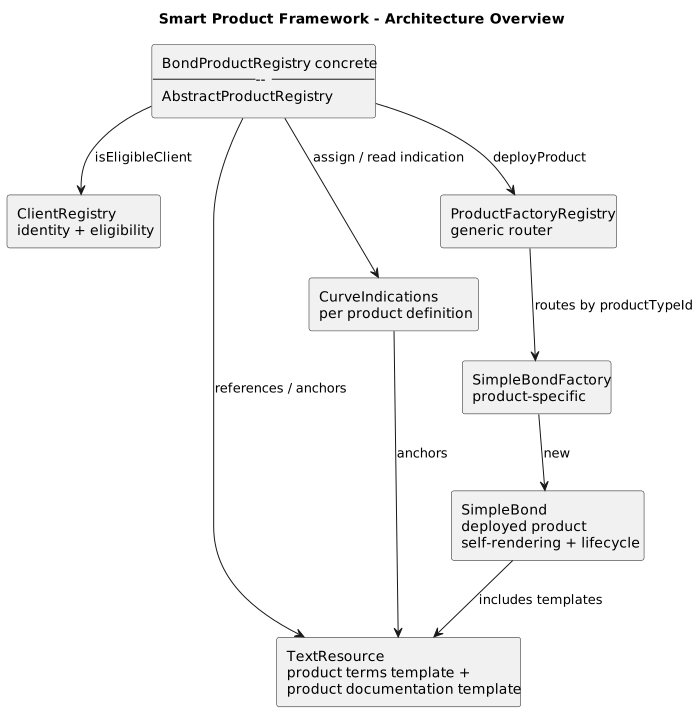
Modules
1. Text Resources
Immutable on-chain storage for large text, including product terms templates and product documentation templates, stored as SSTORE2-chunked bytecode.
| Contract | Role |
|---|---|
ITextResource |
Read/lifecycle interface (ERC-165), including the canonical finalized-content Web3 URL. |
TextResource |
Chunked storage, hash verification, reconstruction. One-shot or staged publishing. |
- One-shot: full content in the constructor (small resources, ≤ EIP-3860 init-code limit).
- Staged:
appendChunkacross transactions, thenfinalize(large resources). - Integrity:
contentHash() == keccak256(content()), verified on-chain at finalization and reproducible off-chain (keccak256(fetchedBytes) === contentHash()). - Canonical URL: after finalization,
web3Url()returnsweb3://<resource-address>:<chain-id>/content. - Chunk size bounded by
MAX_CHUNK_SIZE = 20_000(< SSTORE2's 24 KB limit). - Uses
mcopy(EIP-5656) — requires Cancun EVM.
2. Client Registry
Source of truth for client identity, lifecycle, and eligibility.
| Contract | Role |
|---|---|
IClientRegistry |
Interface. |
ClientRegistry |
Deployable (Ownable2Step). |
- Lifecycle:
Unknown → Active → {Suspended, Revoked};Revokedis terminal. - Registered = known to the system (
status != Unknown). - Eligible =
Active+ derived per-product-definition rules (Option B / derived model;productDefinitionIdreserved for future per-product-definition criteria).
3. Product Registry
A product definition anchors a reusable product terms template and product documentation template and manages their lifecycle. One product-agnostic abstract registry coordinates definitions, indications, client eligibility, trade requests, and product deployment; the concrete registry supplies only product-family acceptance rules.
| Contract | Role |
|---|---|
AbstractProductRegistry |
Product-definition publication, lifecycle, ERC-8100 rendering, resource validation, indication assignment, eligibility-gated trade requests, deployment, and trade-to-product lookup. |
BondProductRegistry |
Concrete bond resource and indication acceptance rules. |
InterestRateSwapProductRegistry |
Concrete swap resource rules; curve symbols remain product terms in the lightweight example. |
productDefinitionId = keccak256(abi.encode(name, address(this)))(name is the unique key; no duplicates, no renaming).partId = uint256(productDefinitionId)(ERC-8100 rendering).- Product definition lifecycle:
Active → {Suspended, Closed} → Archived(terminal). - Resources are validated at publish time: must be
ITextResource(ERC-165), finalized, and of an acceptedresourceTypeper slot.
4. Product Indications
Registries publishing price indications (e.g. yield curves) referenced by product definitions.
| Contract | Role |
|---|---|
IProductIndication |
Generic, product-agnostic interface. |
AbstractProductIndication |
Indication lifecycle, id/partId, rendering dispatch. |
CurveIndications |
Concrete: curve of quotes (Ownable2Step). |
indicationCategory()(e.g.keccak256("CURVE")) is a coarse tag; the product registry maps category → accepted product types (many-to-many) via_isAcceptedIndication.- One indication per product definition (replaceable, shareable across product definitions).
- Curve quotes have their own sub-lifecycle (
Active/Withdrawn); full re-publish overwrites the active board.
5. Product Factories
Two-tier factory: a generic router over product-specific builders.
| Contract | Role |
|---|---|
IProductFactory |
Generic, registry-facing interface. |
IProductSpecificFactory |
Product-specific, generic-facing interface. |
ProductFactoryRegistry |
Generic: productTypeId → specific factory registry + routing (Ownable2Step, ReentrancyGuard). |
AbstractProductSpecificFactory |
Base: caller guard, schema check, deploy hook. |
SimpleBondFactory |
Concrete: builds SimpleBond. |
InterestRateSwapFactory |
Concrete: validates the seven-field swap payload schema and builds InterestRateSwap. |
- Call chain (each access-controlled):
registry → generic factory → specific factory → product. productTypeIdis defined by the specific factory (address-independent semantic constant), read by product providers when publishing product definitions.productSpecificPayloadis opaque to the generic layer; the specific factory validates its schema hash and forwards raw bytes to the product.
6. Products
Deployed trade instances that resolve their own state for rendering and run a generic trade lifecycle.
| Contract | Role |
|---|---|
IProduct |
Deployed-state getter surface + StateUpdated. |
ITradeLifecycle |
ERC-6123-inspired incept/confirm/cancel lifecycle. |
AbstractProduct |
Immutable deployment state, lifecycle state machine, XML scaffolding. |
SimpleBond |
Concrete demo: negotiable notional / maturity. |
InterestRateSwap |
Concrete demo: fixed/floating swap terms, party direction, and symbolic forward/discount curves. |
- Self-rendering: the product implements the
evmstate:callgetters the product terms template references (e.g.notional(),maturity()). The template isxi:included belowProductResources/ProductTermsTemplateand resolved against the live product. - Trade lifecycle:
Requested → Incepted → Active, withCancelled(pre-activation, terminal). - Terms agreement: both parties commit to
currentTermsHash()(economic terms bound to the instance and itsdeploymentStateHash); terms frozen at inception. - Authenticity:
productSpecificFactory()(constructormsg.sender) +IProductSpecificFactory.isFactoryDeployedProduct(product)form a bidirectional proof.
End-to-End Flow
For a runnable walkthrough, including historical XML views of the product lifecycle, see End-to-End Workflow Demo.
- Publish resources — deploy and finalize
TextResource(productTermsTemplate)andTextResource(productDocumentationTemplate). - Publish product definition —
registry.publishProductDefinition(name, {productTermsTemplate, productDocumentationTemplate, productTypeId}). - (optional) Assign an indication — the bond demo calls
registry.assignProductIndication(productDefinitionId, curve, indicationId); the lightweight swap carries symbolic curve assignments in its product terms instead. - Register client — clientRegistry.registerClient({client, lei}).
- Request trade — registry.createTradeRequest({productDefinitionId, schemaHash, payload}):
- checks product definition is Active, client is eligible, product type is deployable;
- deploys the product via the factory chain;
- records tradeId -> product and anchors deploymentStateHash.
- (optional) Amend — product.updateTerms(payload) (client, while Requested).
- Incept — product.inceptTrade(agreedTermsHash) (product provider) -> Incepted.
- Confirm — product.confirmTrade(agreedTermsHash) (client) -> Active.
- Render — the renderer calls
product.stateXmlTemplate(), resolves theevmstatebindings, and the frontend applies the product documentation template.
Interest Rate Swap Example
The Interest Rate Swap Demo applies the same compact framework to a second product family. Its FpML-shaped terms include the notional, currency, maturity, fixed swap rate, payer/receiver direction, and two symbolic curve assignments. The runnable Java example demonstrates the ERC-6123-inspired incept/confirm agreement and prints grouped historical XML URLs for the product-definition publication and the initial request, amended request, inception, and confirmation states.
Key Conventions
Identifier & hash schemes
| Value | Definition |
|---|---|
TextResource.contentHash |
keccak256(content) |
productDefinitionId |
keccak256(abi.encode(name, address(registry))) |
partId (productDefinition) |
uint256(productDefinitionId) |
indicationId |
implementation-defined; obtain partId via partIdForIndication (do not assume uint256(id)) |
productTypeId |
address-independent semantic constant (e.g. keccak256("SIMPLE_BOND")) |
tradeId |
keccak256(abi.encode(registry, chainId, nonce, client, productDefinitionId)) |
deploymentStateHash |
keccak256(abi.encode(registry, chainId, tradeId, product provider, client, productDefinitionId, productDefinitionVersion, productTypeId, productTermsTemplate, productTermsTemplateContentHash, productDocumentationTemplate, productDocumentationTemplateContentHash, schemaHash, keccak256(payload))) |
currentTermsHash |
keccak256(abi.encode(product, deploymentStateHash, economicTermsHash)) |
Shared constants
Domain identifiers must be centralized to prevent drift
across the registry, factories, indications, and text-resource classification,
e.g. BondConstants.sol and SwapConstants.sol:
SIMPLE_BOND_TYPE,COMMERCIAL_PAPER_TYPECURVE_INDICATION_CATEGORYBOND_PRODUCT_TERMS_TEMPLATE_RESOURCE_TYPEBOND_PRODUCT_DOCUMENTATION_TEMPLATE_RESOURCE_TYPEINTEREST_RATE_SWAP_TYPEINTEREST_RATE_SWAP_PRODUCT_TERMS_TEMPLATE_RESOURCE_TYPEINTEREST_RATE_SWAP_PRODUCT_DOCUMENTATION_TEMPLATE_RESOURCE_TYPE
⚠️ Off-chain deploy scripts must set each
TextResource'sresourceTypeusing the same values, and product providers must publish product definitions with aproductTypeIdobtained from the deployed factory'sproductTypeId().
Rendering (ERC-8100 / evmstate)
- Product definitions and products group their resources under
ProductResources, with separateProductTermsTemplateandProductDocumentationTemplatechild elements. - Product definitions expose both templates inside those child elements as
inert text (
parse="text"); bindings remain unresolved. - Product-definition views always include a
ProductIndicationAssignment: initiallyassigned="false", thenassigned="true"with the indication contract address, indication ID, and state-part ID. Live indication content remains in the separately rendered indication contract. - Products include both templates inside those child elements as XML
(
parse="xml"). Bindings in the product terms template resolve against the live product getters; the product documentation template remains inert as a transformation until the frontend applies it to the resolved product state. - Product-definition and product XIncludes obtain their resource URLs directly
from
ITextResource.web3Url(). - Dynamic collections (e.g. curve quotes) use the array-of-struct profile:
evmstate:call="...(tuple(...)[])",evmstate:item-element,evmstate:item-field. - State-part templates may bind a callback's single
uint256input to the renderer context withevmstate:args="$partId". Arbitrary or literal arguments remain unsupported. - Resource integrity is carried inline via
evmstate:integrity="keccak256-0x…".
Deployment Order
- ClientRegistry(owner)
- BondProductRegistry(owner, clientRegistry)
- ProductFactoryRegistry(owner, registry)
- registry.setProductFactory(productFactoryRegistry) # back-ref check
- SimpleBondFactory(productFactoryRegistry) # generic addr
- productFactoryRegistry.registerProductFactory(SIMPLE_BOND_TYPE, simpleBondFactory) # ERC-165 + type match
- Deploy and finalize
TextResource(productTermsTemplate)andTextResource(productDocumentationTemplate) - CurveIndications(owner) + publish curve indications
- registry.publishProductDefinition(…)
- registry.assignProductIndication(…)
- clientRegistry.registerClient(…)
Dependencies
| Package | Used for |
|---|---|
@openzeppelin/contracts |
Ownable2Step, Strings, IERC165, ReentrancyGuard |
solady |
SSTORE2 (chunked resource storage) |
- Solidity:
^0.8.24 - EVM version: Cancun (required for
mcopyin resource/product XML paths)
Status
⚠️ Prototype / demo. Not audited.
SimpleBondDemoandInterestRateSwapDemoare minimal examples; real products will extend the trade lifecycle with product-specific phases (for example issuance/coupons/redemption or fixing/valuation/settlement) on top ofActivevia the_onActivatedhook.